Showing posts with label Conference. Show all posts

12/16/19

Inspired by Nashville #ldeigratitude

By Shara Bohach

The LDEI conference in Nashville was incredibly inspiring and the Nashville Dames really went above and beyond. From the welcome bag full of goodies, to the programming and evening sessions, conference was full of inspiring words, truly delicious food and drink, and wonderful music.


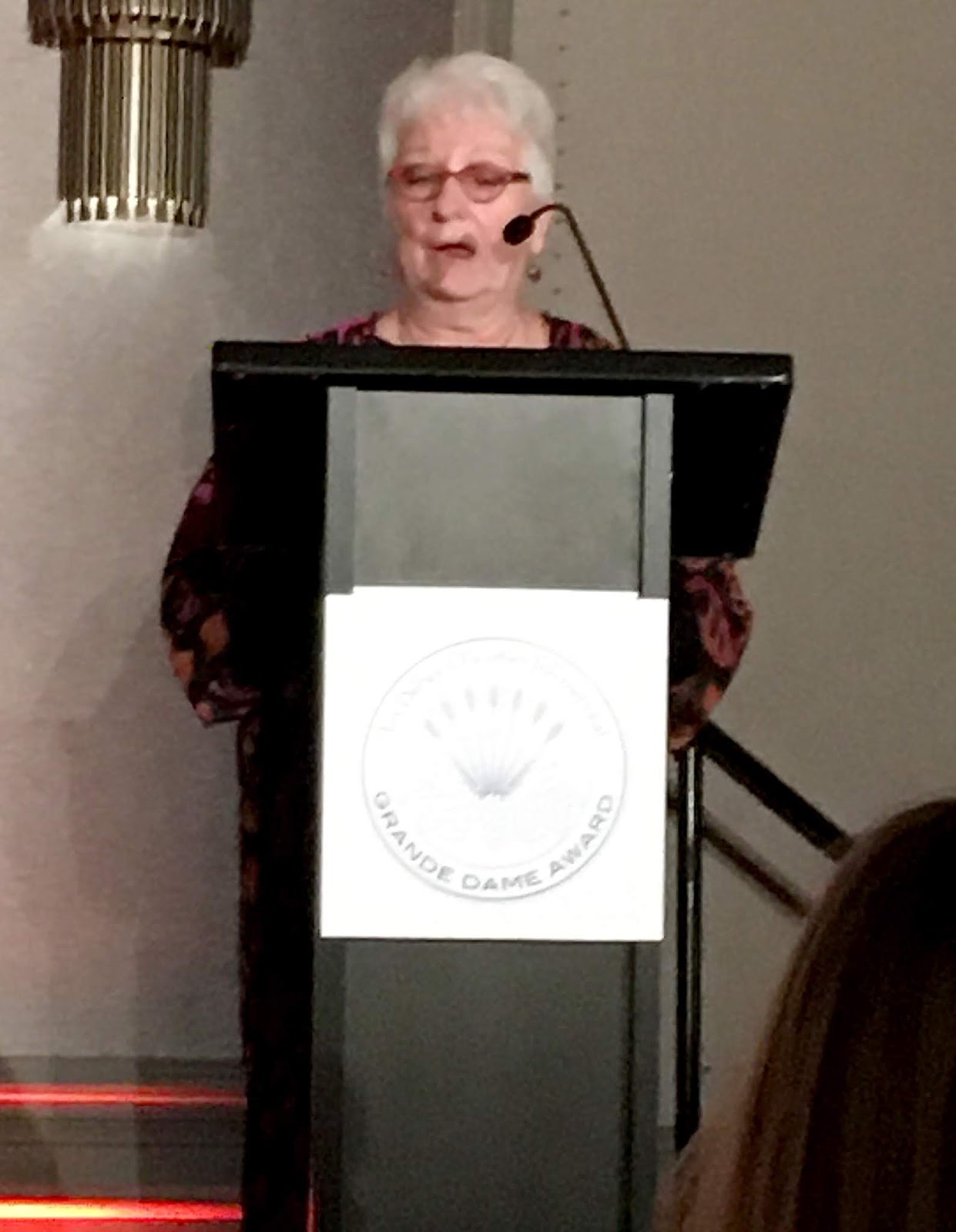
We were collectively brought to tears by several touching moments. There wasn’t a dry eye when Becca Stevens presented the video for “Love Heals” – a song written by her Grammy-winning songwriter husband, sung by their son, inspired by her book of the same name, with the video lip synced by the women she has helped to heal. Not a dry eye when LDEI Founder Carol Brock stood and thanked everyone for all of the love, support and cards during her illness, and said it is what pulled her through. And a personally moving moment at the Grande Dame reception, when our own Bev Shaffer took the stage to become LDEI president, with her husband John seated at the front table with us cheering her on.

Themes and Mantras
There were some themes that really ran through conference – sentiments heard in multiple sessions from different speakers.

Be Generous
Both with others and with yourself. Be welcoming. We are in the business of hospitality, so show that welcoming spirit to everyone.

Embrace Mistakes
Be generous with yourself – know that you will make mistakes, and that it is ok. You learn more from mistakes than anything else. Grow through them.

Be Authentic
Both as a generality (with yourself and others) and in what you deliver on social media.

Some examples…

Keynote speaker Maneet Chauhan, a sparkly, effervescent owner of 4 restaurants and 3 breweries, enthused that the more genuine you are on social media, the more engagement you will get. She had someone else do it for a while and engagement went way down. People knew it wasn't her. She now responds to every single post.

The Doing Digital Right session emphasized that social media has to be authentic and personal. The rough-around-the-edges posts get the best response because they show real life. Show them the behind the scenes, and the gritty mishaps. It's about the people not the product. It’s not about selling the sweatshirts – but you might be wearing the sweatshirt in the video you post!

Carla Hall talked about how insecurity kept her from being authentic early on. How nervous she was on her first competition show against younger chefs. She told us of ups and downs and the voice of self-doubt. Her advice? Ask yourself what is the worst thing that could happen? If it's not death, then that's a calming realization and you will be ok.

She also emphasized that without adversity and conflict you will never grow. In the face of adversity, seek out the knowledge you need to make yourself better. This will give you the confidence to do it. You grow through it. Learn to be comfortable with the uncomfortable. Facing adversity, you can feel defensive, but it is better to ask yourself why you are facing it, and advocate for yourself and prove yourself.

Stronger Together
Another thread through conference was strength in women, and being stronger together through LDEI.

Over a delightful Bollywood breakfast, keynote speaker Maneet Chauhan talked about growing up in India, living and working in New York, and what led her and her family to end up in Nashville, where they have built so much. She shared thoughtful insights about how she has become so successful in this male dominated field.

  • There are no shortcuts to success – her parents instilled in her that you must work hard, and be the best.
  • Work-life balance doesn't exist. Balance comes from living in the moment, and giving 100% at that moment. That way you can be fair to your work, and fair to your family.
  • Reaching goals, no matter how outrageous – you set them, meet them, and then set the next goals. Dream big.
  • Have the adaptability to change course.
  • Generosity – be generous with others and yourself. You will make mistakes, it's ok. You learn more from mistakes than anything else.
  • It’s all in your attitude. Always be ready to learn. Every person you meet has something to teach you, so be open to that.

She also left us with a quote that resonated.
“A rising tide raises all ships. We are all ships and LDEI is our tide.”

The Nashville conference was 3 days of non-stop inspiration, friendship, music, food and drink. It truly lived up to its tagline “Rhythm and Roots.” A month and a half later, back in the hectic pace of things, I still feel recharged and inspired to honor and practice the mantras I heard again and again at conference. #ldeigratitude to the Nashville Dames.

11/18/19

Our ‘Jersey Girl’ Is In the House!

By Elaine Cicora
Photos by Shara Bohach and Mike Matson-Mathes

Les Dames d'Escoffier International (LDEI)
President, Bev Shaffer

Five Dames from Cleveland were among more than 300 members cheering on our own Bev Shaffer last month, as she assumed the presidency of the national LDEI board. Bev stepped into her new role on Saturday, Oct. 26, in Nashville, Tennessee, during the 2019 LDEI Conference.

For the five of us in the audience – Beth Davis-Noragon, Britt Horrocks, Carol Hatcher, Shara Bohach and myself – it was a moment of immense pride, as it was for Bev’s husband, John, and son, Ray, who also were on hand to celebrate her accomplishment.

A New Jersey native and long-time resident of Medina, Bev has an impressive, 30-year collection of culinary bona fides to back her up. Most recently she was Corporate Chef and Manager of Recipe Development for Vitamix World Headquarters. She has authored six cookbooks, developed over 18,000 recipes, and has written about food and travel for several Cleveland newspapers and magazines. She produced an award-winning television series for cable TV and has cooked and presented at the James Beard House in New York.

She is also a founder and past-president of the Cleveland LDEI chapter, where she remains a highly respected and deeply committed member.

Prior to her appointment as president, Bev served on the LDEI board contributing expertise in the areas of sponsorship and partner development, new chapter outreach and chapter communication. She follows immediate past-president Ann Stratte, from Washington, D.C., into the one-year position. Among Bev’s initiatives will be crafting a Strategic Plan for the organization and encouraging the membership to take time to practice gratitude. She invites all members to share with her what they are grateful for, either by email or on the LDEI social media platforms with #ldeigratitude.

If you haven’t yet had a chance to congratulate Bev, please take a moment to do so now.


Cleveland Dames from left, Shara Bohach, Beth Davis-Noragon,
Carol Hacker, Elaine Cicora, Bev Shaffer, Britt-Marie Horrocks

From left. Grande Dame Nora Pouillon, Ann Stratte,
Founder Carol Brock, President Bev Shaffer, Hayley Matson-Mathes

Outgoing LDEI President Ann Stratte
congratulating incoming LDEI President Bev Shaffer

11/12/19

Bev Shaffer Named President of Les Dames d’Escoffier International

Bev Shaffer, President
Les Dames d’Escoffier International
Bev Shaffer Named President of Les Dames d’Escoffier International

On Saturday, October 26, 2019, before an audience of over 300 in Nashville, TN, Beverly Shaffer, owner of COOK.WRITE.TRAVEL.REPEAT (a culinary consulting company in Cleveland, OH), was named President of Les Dames d’Escoffier International (LDEI).

LDEI includes over 2,400 women leaders and luminaries in a variety of professions within food, fine beverage and hospitality industries who share a vision to improve lives through education and philanthropy.

Shaffer follows Ann Stratte (Washington, DC) who will serve as past president on the board of directors. Shaffer will guide the organization over the next year and assist in the development of the 2020 conference slated for Oct. 15-18 in New York, NY.

Prior to her appointment as president, Shaffer served on the LDEI board contributing expertise in the areas of sponsorship and partner development, new chapter outreach and chapter communication. She is a founding member and past president of the Cleveland, OH chapter.

Shaffer brings to the office more than 30 years of culinary experience. Most recently she was Corporate Chef and Manager of Recipe Development for Vitamix World Headquarters. She has authored six cookbooks, developed over 18,000 recipes, and has written about food and travel for several Cleveland, OH newspapers and magazines. She produced an award-winning television series for cable TV and has cooked and presented at the James Beard House in New York, NY.

While all things culinary are at the forefront of Shaffer’s life experience, she is also an advocate and ambassador for the Alzheimer’s Impact Movement and a board member of the Alzheimer’s Association.

LDEI is an international organization of women leaders who create a supportive culture in their communities to achieve excellence in the food, beverage, and hospitality professions. To do this, over 2,400 members in 44 chapters worldwide provide leadership, educational opportunities and host philanthropic events within their communities. For more information, visit LDEI.org, FB, Insta, Linkedin or Twitter

11/4/19

The Future of Food

‘What will we eat, and where will it come from?’ is a thru-line at the 2019 LDEI Conference

Story and photos by Elaine T. Cicora

Who doesn’t like to eat? But in a future dominated by population growth, a shrinking land supply, and the changing demographics of the American farmer, fulfilling that need may become a challenge.

In several Conference sessions, attendees received surprising insights into the future of food.

Author, Amanda Little
In a fascinating Friday session entitled The Fate of Food: An Irony of Hunger and Waste, author and journalism professor Amanda Little walked us through a central paradox: Our global population is expanding, and as people attain a more affluent lifestyle, they crave a more intensive diet. Yet the amount of arable land and global crop yields are shrinking – to the point that some experts claim that by mid-century, global warming may reach the point where agriculture can no longer support the human population.

While that is a terrifying conclusion, Amanda has spent years investigating the realities. The result is her book, The Fate of Food, a text that explores the intersection of environment and technology and finds reasons for hope.

After more than 5 years of international reporting on “new normalities” like shifting seasons, warming waters, insect and disease infestations, and the profound disruptions in production that are facing growers all over the world, Amanda has concluded that the thru-line is climate change. “Climate change is something we can taste,” she told attendees. “This is not partisanship. Climate change is of interest to anyone who eats.”

Of course, there is an additional paradox to consider: While agriculture is highly vulnerable to climate change, it is also its major driver. Among its impacts, agriculture uses more than 70 percent of the world’s fresh water; one-third of the world’s grain goes toward feeding livestock; agro-chemicals contribute to greenhouse gases and decimate beneficial insect populations; and even the very fact of tilling the soil releases carbon into the air. The result, Amanda says, is that technology has “real motivation” to find some solutions.

On the horizon are things like an AI weeder, which can kill tiny weeds with a small but intense blast of fertilizer; “toilet to tap” processes that yield drinkable water from treated sewage; “smart water networks” that use nanotechnology to find and repair pipe leaks; nutrition pellets created by 3-D printers; and cell-based meats, an outgrowth of medical research, that are grown in laboratories

At the same time, the author notes, many of us are deeply skeptical of technology’s ability to solve the problems: Historical fixes, after all, have led us to a landscape dominated by agro-chemicals, GMOs, monoculture, and preserved convenience foods. No surprise we are deep in a period of “food nostalgia,” that has launched everything from agro-tourism to a renaissance in backyard gardening
“There is so much we can learn from the past,” Amanda said, especially when it comes to things like ways to build healthy, resilient soils. But, as many of us realize, the chances of each family growing enough food to be self-sustaining are slim.

So what is the way forward? “It is not tech,” the author told us. “And it is not Little House on the Prairie.” But there is a third path, she says, that integrates the best of both worlds and can help solve the coming problems.

From left, Peggy Marchetti Madison, Kia Jarmon,
Dame Sylvia Ganier, and Caroline McDonald
On Saturday, in a panel discussion entitled Women on the Farm: Creativity and Agro-tourism, attendees heard from three farmers and one communications pro – women, all – who are forging that path.

Dame Sylvia Gainer, owner of the 350-acre Green Door Gourmet organic farm outside Nashville, served as moderator and opened the presentation with some vital statistics: According to the USDA, the average farmer is white, male and 59 years old.

Change, however, is coming in the form of female farmers; in fact, Sylvia said, one-third of all new farmers are women. Joining Sylvia were Caroline McDonald, who operates a half-acre, intensely planted, no-till market garden; Peggy Marchetti Madison, who owns 38 acres, with 6 in flower production; and Kia Jarmon, PR and communications pro in Nashville.

Thanks to the local food movement, the growth of farmers’ markets, and the boom in agro-tourism, the skills of female farmers are now in great demand, the speakers agreed. Most especially, women’s ability to tell the stories behind the food is enormously important, particularly in light of educating non-farmers in the nutritional, culinary and sustainability aspects of locally grown products.

“We are naturally storytellers,” Kia explained. “But it matters how we tell our stories and that we don’t discount our achievements. Our message should not just be, ‘I have a garden,’ but, ‘I am feeding my children, I am working against climate change.’”

Women also need to take back the narrative, the panelists agreed. For instance, while male commodity farmers usually get the most attention, it is women who have traditionally grown the food and medicine. “What fed my family growing up was the half-acre garden that my mom and grandma had,” said Peggy. “Women have always been farmers; they just called us gardeners.”

The panelists suggested a variety of ways to support emerging female farmers. Among them:
  • Stop denigrating farming as a “bad job choice” for young people. Instead assure young women that, with mentoring, they will find farming to be “a wonderful way to make living,” and “an economically viable career choice.”
  • Amend laws to help keep family farms in the family.
  • Help ensure women have equitable access to land and money.
  • Remember that, when it comes to acreage and equipment, bigger is not always better. “You don’t need a lot of fancy stuff; you just need to do what you do best,” said Peggy.
  • •And finally, respect female farmers’ expertise. “When you go to the farmers’ market, talk to the female farmers,” said Peggy. “They are the ones with the knowledge. They’re the ones whose butts are off the tractor and whose hands are in the dirt.”

11/16/18

What I Learned at Conference

By Elaine Cicora

Cannabis Cuisine Panelists (from left to right): Jodi Hall, Jessica Tonani, and Tamara Murphy


It took me nine years to catch on to the LDEI Conference. Over that time, I found plenty of reasons to ignore it: The late-October date seemed dreary. The cost seemed high. There would be flights to book. And how the heck was I supposed to figure out all the registration details?

But eventually, I started to come around. Sure, Dame Carol Hacker’s oft-repeated claim that, “You can’t turn around at Conference without somebody putting a plate of food or a glass of wine in your hands!” sounded tempting. But it wasn’t until last year that it finally hit me: Conference and commitment to our mission could go hand-in-hand.

Of course it is possible to be a leader within the chapter and never attend a Conference. But – and this is a big one – it is almost impossible to overstate the value of sharing your successes, your challenges and your questions, one-on-one, with Dames from around the world, who have already traveled down those roads before you. What you learn at Conference – and you will learn a lot – makes you a stronger, smarter and more effective member of your chapter, and makes your chapter better for it.

Sales pitch aside, here are four quick learnings I brought back from this year’s Seattle Conference. They got me thinking about “best practices.” Perhaps they will do the same for you.

LDEI membership is a privilege. Everyone who applies need not be accepted. Recruitment efforts should be strategic, aimed toward finding the types of members your chapter needs, and focused on women who are ready to lead.

Fundraising need not be limited to one blowout event per year. Some chapters hold one or more small, ticketed events throughout the year, i.e., dinners, speakers, panel discussions. And don’t forget silent auctions; in San Antonio, the silent auction associated with their main fundraiser brings in 50 percent of their profits!

Many chapters regularly engage in community work, doing things like teaching healthy cooking classes at food pantries, and gathering and donating farmers’ market leftovers to soup kitchens. The San Antonio chapter holds an annual on-site, catered Holiday Dinner for abused children that includes tree trimming, gingerbread-house decorating, and gifts. “It feels so good to make someone happy, and we Dames just get tighter and tighter,” chapter president Blanca Aldaco told us.

And finally, this – not from fellow Dames but from presenters at one of our concurrent sessions: Cannabis cuisine is the wave of the future. Among the speakers was Jody Hall, founder of The Goodship, producer of delicious, and strictly dosage controlled, marijuana-laced cookies and candies. Want to make “tons” of money? Cannabis cuisine could be your ticket. “Make it delicious, make it low dose, and make it easy for people to take to a concert or a party,” advised Jody. Currently, marijuana is an $800 million industry in Washington, we were told; the rest of the nation can’t be far behind.

The 2019 conference is in Nashville, Oct. 24 through 27. Maybe this is your year to attend?


For more on the 2018 Conference, go here, and be sure to grab the Winter Quarterly when it arrives: It will be full of Conference stories.

A Message From Our President

From Beth Davis-Noragon

Hello, Cleveland Dames!

I know I speak for the entire board in sharing with you how pumped up we got at the National Conference in Seattle last month. It’s all about the connections we make there. For one lucky Cleveland Dame, this was her first conference. Others of us are starting to approach double-digit attendance. And even though each conference is unique in programming and entertainment, common threads continue to surface. We make connections and discover that we are not alone in our struggles.


The perfect metaphor materialized in our last evening there, at Emerald City Trapeze. This 20,000-square-foot venue is housed in the former Canal Boiler Works building. Heavy hors d’oeuvres were expertly prepared, and we even had our own signature cocktail, the “Oui, Chef” (each garnished with its own wee chef). But the real fun began as the lights dimmed and the security nets were drawn: our own, close-up trapeze show. It was thrilling. There were a half-dozen daring flyers, spinning and flipping through the air to the catcher as he cried, “Hep!” (which is trapeze for “go”). We screamed and cheered them on, and they made every catch until the last one. Oh, we were disappointed! But the flyer was not deterred! He tried three more times to make the most complicated flip of the evening, eventually choosing to call it off. The troupe worked together to make their connections, and even when one of them stumbled, the rest of the troupe was there for support. Why? They have all fallen into the net.

I encourage each of you to start thinking about National Conference 2019 in Nashville now. Work toward the Chapter scholarship. Think about how you can get there otherwise. Put away $75 a month toward the fees. Make the connections and share the struggles. HEP!